Domanial Forest of Barbeau
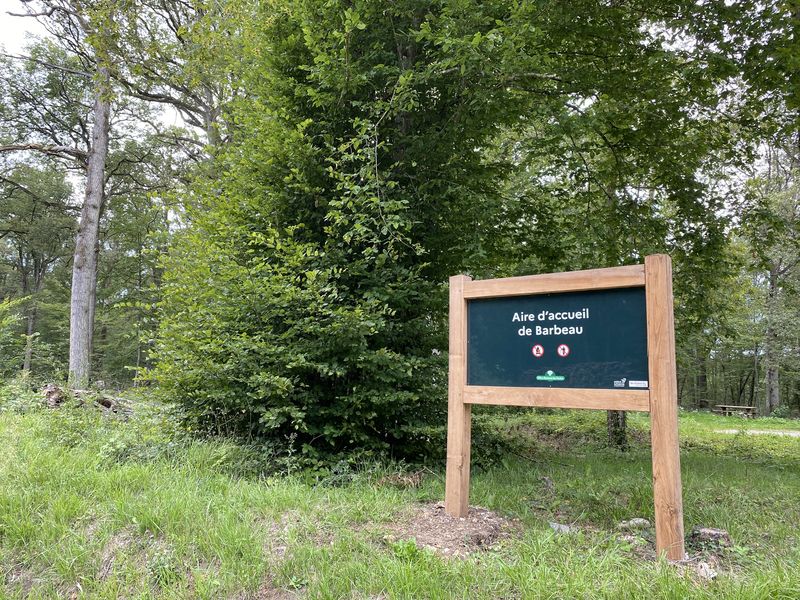
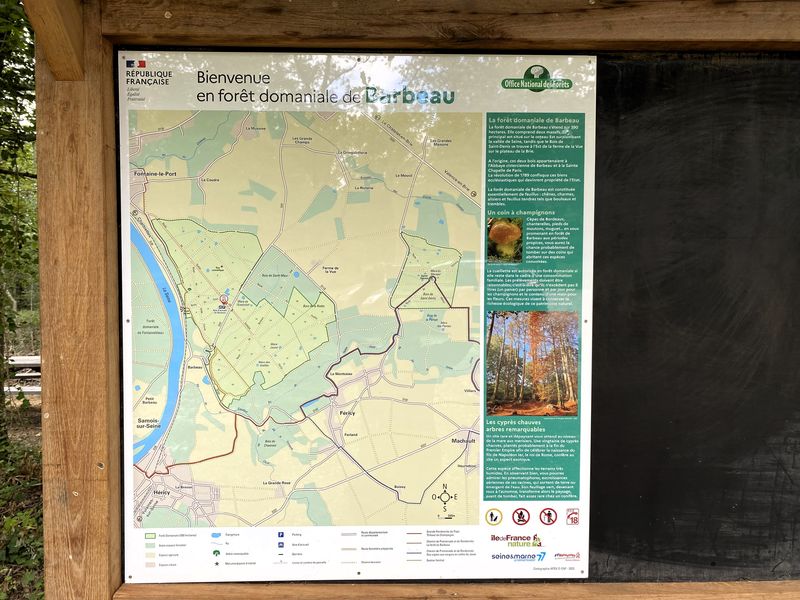
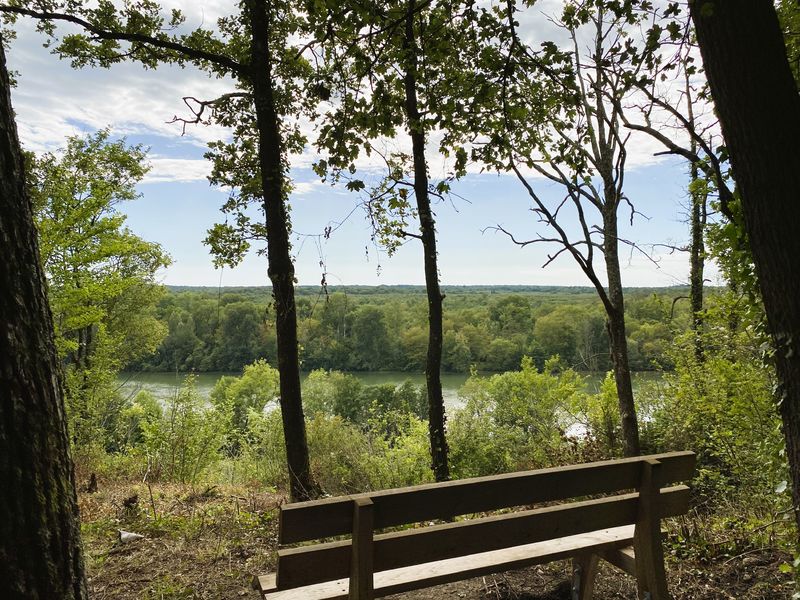
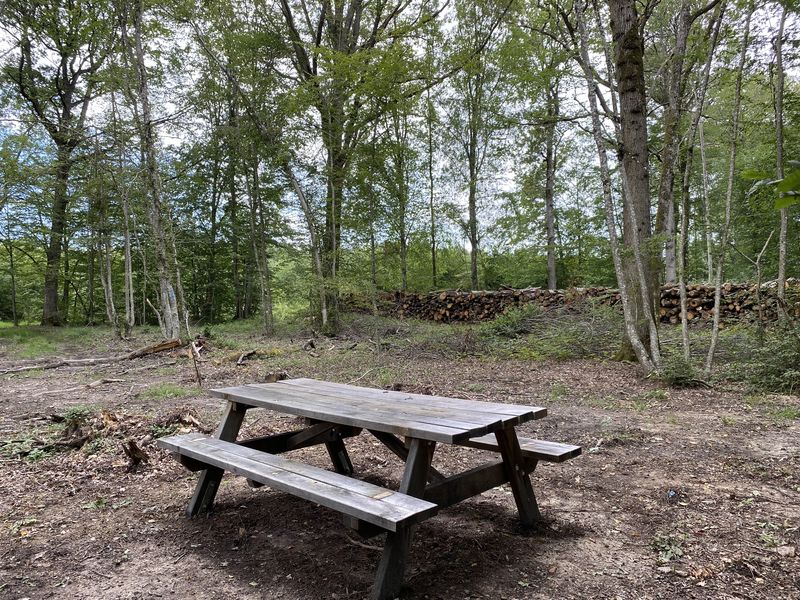
Located between Fontaine-le-Port and Féricy, the Domanial Forest of Barbeau offers vast panoramic views of the Seine and the Fontainebleau massif. This forest is home to sessile oaks, dominant, with a hornbeam understory.
Route de Féricy
77590 Fontaine-le-Port
77590 Fontaine-le-Port
The massif of approximately 390 hectares has the particularity of being located on a limestone base covered by silt, clay, sand and Brie millstone. The lack of relief of this plateau and the presence of clay mean that rainwater has difficulty infiltrating, stagnates and made necessary the creation of drainage canals.
Its other particularity is to still be treated, in almost its entirety, as coppice with standards, a result of its historical heritage.
Indeed, it was until the Revolution, an ecclesiastical wood, placed under the authority of the Maîtrise des Eaux et Forêts which authorised it to practice this type of exploitation. The products served to supply Paris with firewood and framework and were transported very easily by the Seine from two landing stages at Fontaine-le-Port, so aptly named.
Managed by the Office National des Forêts, the Barbeau forest is a production forest.
It hosts several American red oaks and bald cypresses, species native to Florida.
In the heart of the Barbeau forest, scientists have installed a measurement station, equipped with sensors that allow the measurement of matter and energy exchanges between the forest ecosystem and the atmosphere. Indeed, since 2003, the Plant Ecophysiology team of the ESE Laboratory (CNRS / Université Paris-Sud / AgroParisTech) has been working on an experimental forest site. Their activities are focused on understanding the processes that govern the functioning of the tree and the forest ecosystem as a whole. Since 2005, a major investment has been undertaken on the site, notably through a measurement station located at the top of a 35-metre-high pylon and dedicated in part to measuring exchanges of carbon dioxide (CO2) and water vapour (H2O) between the forest and the atmosphere. The Barbeau site is part of the ICOS network (Integrated Carbon Observation System), a new European research infrastructure dedicated to the observation and precise monitoring, over the long term (more than 20 years), of greenhouse gas fluxes. ICOS tracks carbon fluxes in Europe and the surrounding areas by measuring ecosystems, the atmosphere and the oceans through a network of integrated measurements.
Its other particularity is to still be treated, in almost its entirety, as coppice with standards, a result of its historical heritage.
Indeed, it was until the Revolution, an ecclesiastical wood, placed under the authority of the Maîtrise des Eaux et Forêts which authorised it to practice this type of exploitation. The products served to supply Paris with firewood and framework and were transported very easily by the Seine from two landing stages at Fontaine-le-Port, so aptly named.
Managed by the Office National des Forêts, the Barbeau forest is a production forest.
It hosts several American red oaks and bald cypresses, species native to Florida.
In the heart of the Barbeau forest, scientists have installed a measurement station, equipped with sensors that allow the measurement of matter and energy exchanges between the forest ecosystem and the atmosphere. Indeed, since 2003, the Plant Ecophysiology team of the ESE Laboratory (CNRS / Université Paris-Sud / AgroParisTech) has been working on an experimental forest site. Their activities are focused on understanding the processes that govern the functioning of the tree and the forest ecosystem as a whole. Since 2005, a major investment has been undertaken on the site, notably through a measurement station located at the top of a 35-metre-high pylon and dedicated in part to measuring exchanges of carbon dioxide (CO2) and water vapour (H2O) between the forest and the atmosphere. The Barbeau site is part of the ICOS network (Integrated Carbon Observation System), a new European research infrastructure dedicated to the observation and precise monitoring, over the long term (more than 20 years), of greenhouse gas fluxes. ICOS tracks carbon fluxes in Europe and the surrounding areas by measuring ecosystems, the atmosphere and the oceans through a network of integrated measurements.
Tarifs
Free access.
Périodes d'ouverture
All year round daily.